The wall window
A wall-mounted panel sized for a single living-room or bedroom wall. Hangs like a fine appliance.
$5,000one-time
This section is still under wraps. Enter the password to read on.
That's not the password. Try again.
An ultrabright 3D display that shifts as you move your head — just like looking through a real window.
Close one eye, then move. The window already follows your mouse — turn on the camera and it follows your head instead. With one eye shut, the depth comes entirely from head-tracked motion parallax, the same cue the real product uses. The camera feed stays on your device.
A 40th-floor view over Central Park. A Tuscan hillside. A live feed of family across the world. Or a window onto Mars.
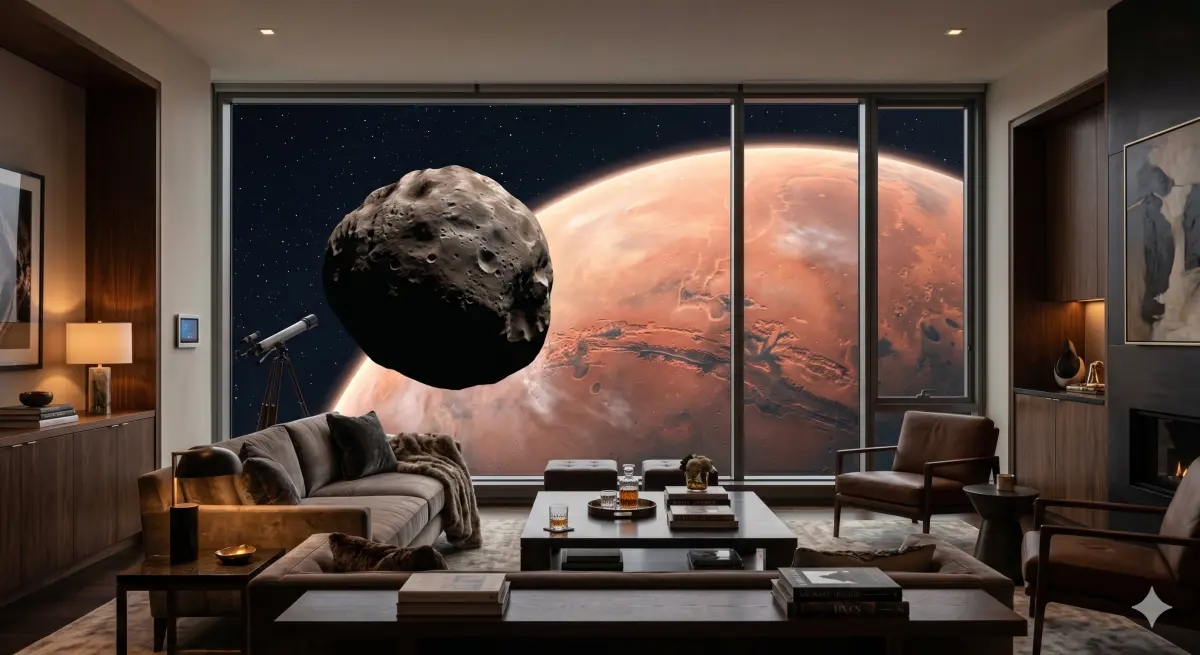
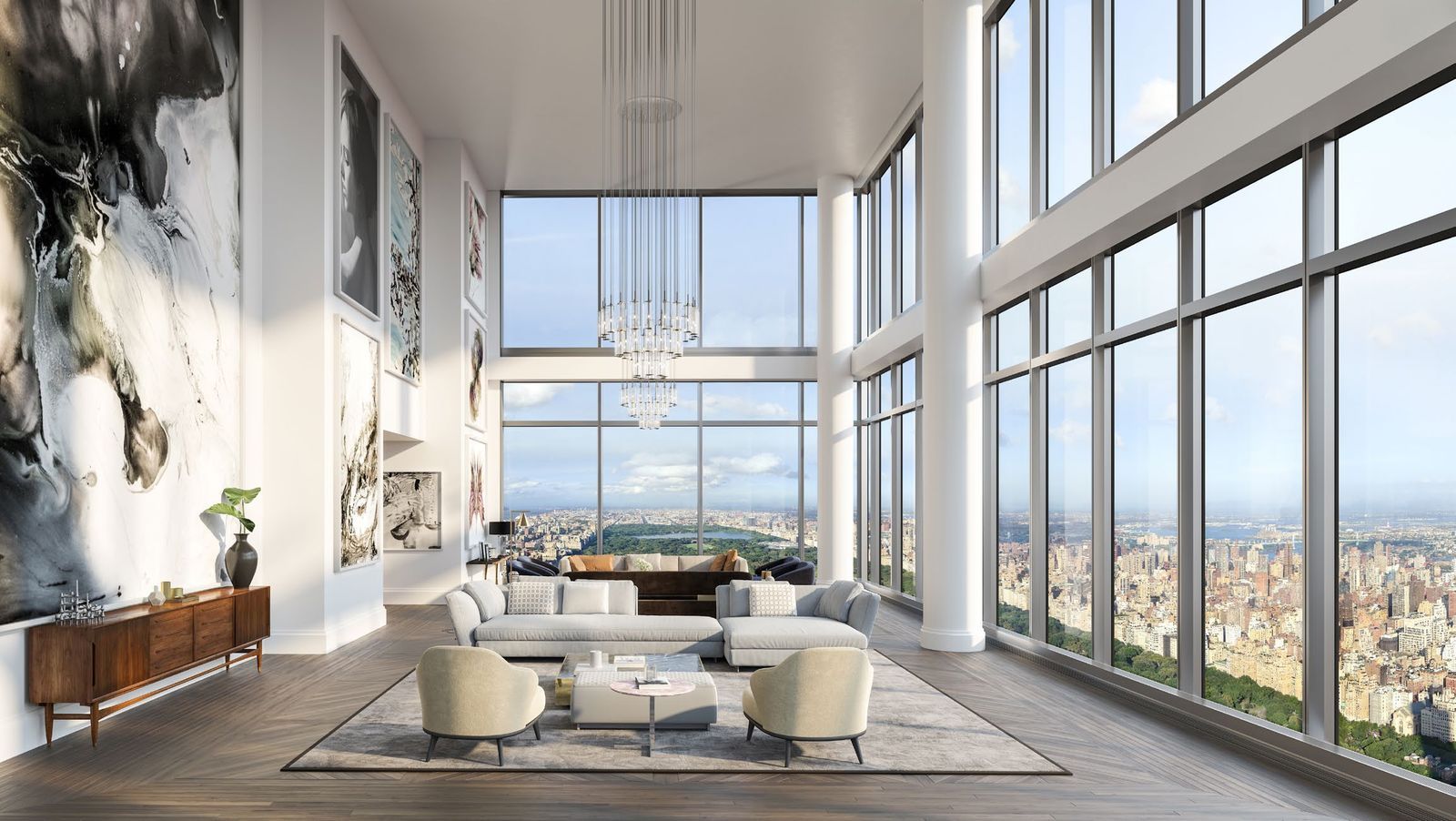
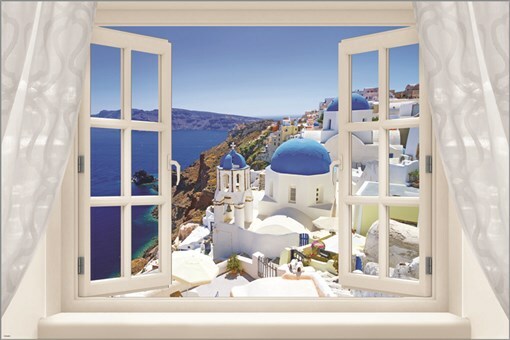
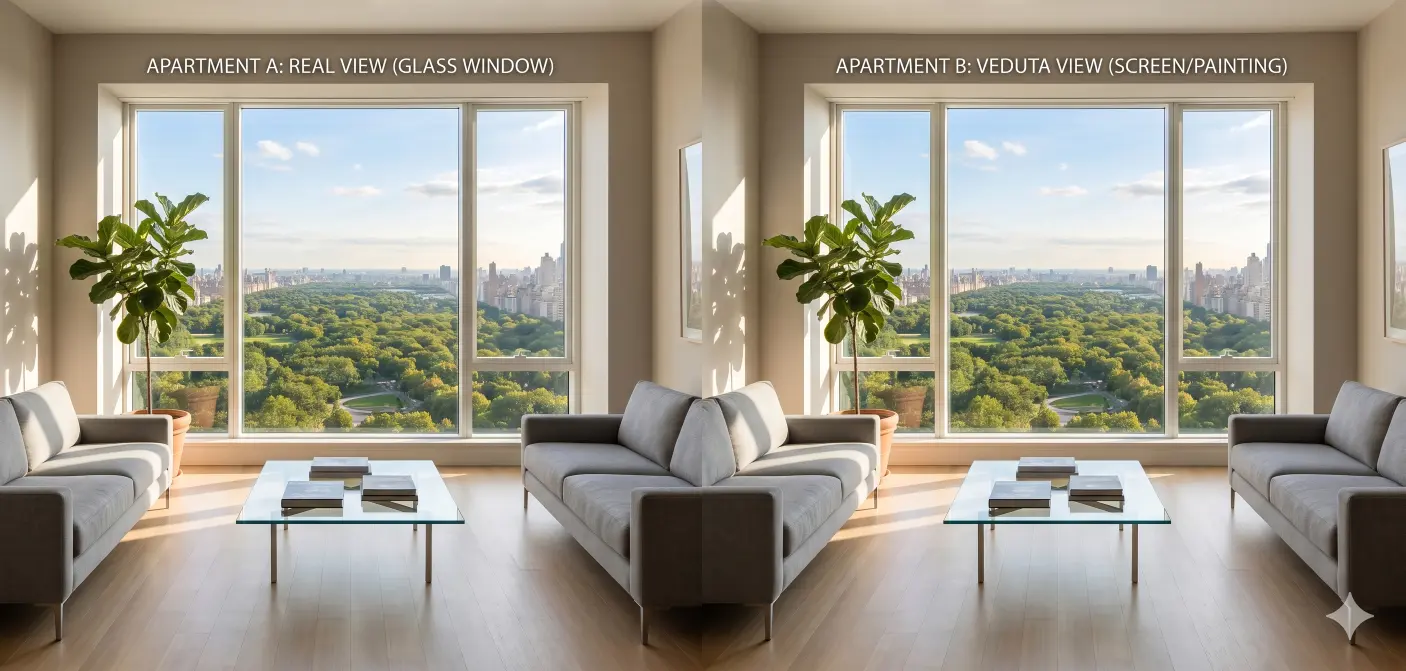
Two windows: One real, one Veduta.
In blind testing, people walk through
both rooms and guess which window is glass. They can't tell which is real!
Our proprietary high-intensity LEDs throw powerful beams of full-spectrum daylight into the room — warm at dawn, brilliant at noon, golden at dusk. It doesn't look like a picture of the sun. It lights the room the way the sun does.
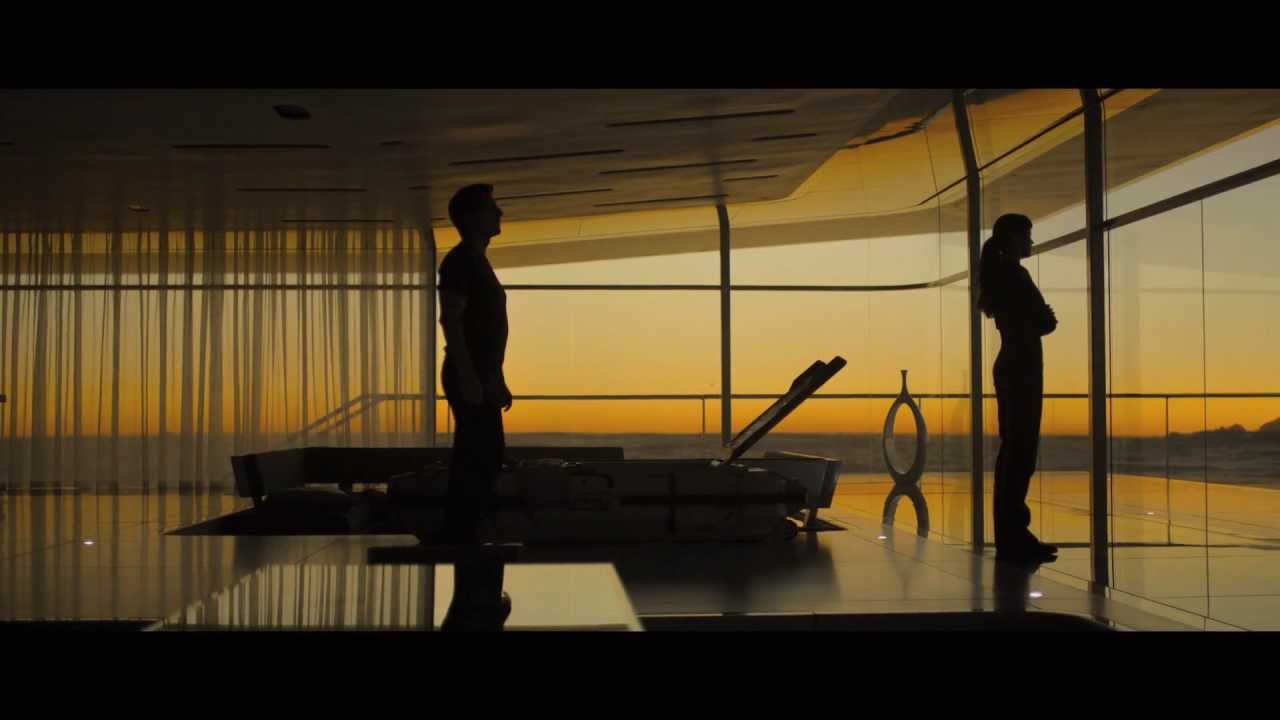
A wall-mounted panel sized for a single living-room or bedroom wall. Hangs like a fine appliance.
A full-height installation. Replaces an interior wall with a penthouse-quality view for any unit on any floor.
Appliance-format. Hinges open like a real casement; a HEPA-filtered fan inside delivers breezes that move with the scene outside.
Sync two windows across the world. Look through to family in real time.
Optional premium-views subscription — $1,000 / year per window — unlocks the curated catalogue (Central Park, Santorini, Mt. Fuji, Mars, etc.) and ongoing content updates. Stock views ship with every unit.
Condo units on the "bad" side of a building — courtyard-facing, brick-wall view, north light — routinely list $50,000–$200,000 below the view-side unit on the same floor. Buy the cheaper unit, and place a Veduta Wall on every interior wall. You are ahead by tens of thousands on day one, with a view the "good" units never had.
* Not yet shipping. Veduta is in development; these prices are indicative of what we are building toward. To join the waiting list, email michael@michaelcurrie.com.
Veduta is a concept we are working on. Interested? Email michael@michaelcurrie.com.
The sun is not "bright." It is overwhelming. A typical screen emits a tiny fraction of full daylight — Veduta closes most of that gap. Brightness is on-demand: the head-tracker dims the panel between viewers and sleeps it when the room's empty, so peak draw only happens when someone's actually looking.
Noon sun is roughly 30,000 nits, or about 100,000 lumens pouring through a 1.5 m² window. Veduta v1 emits about half that — already deep into "daylight indoors" territory, with headroom to climb generation over generation. Why we start here ↗
Get close to an ordinary display and the grid shatters the illusion — your eye locks onto the pixel structure and the scene flattens back to a screen. Veduta packs pixels below the eye's resolving limit, so up close you see the view, not the display.
Real glass gives each of your eyes a slightly different angle — that's stereoscopic depth. Lightweight polarized glasses deliver a separate image to each eye, so the view has genuine three-dimensional depth instead of sitting flat on the wall.

Look through real glass and the scene shifts as you lean and walk. A built-in sensor tracks your head and re-renders the view in real time, so foreground slides past background exactly like life. It tracks one person at a time — which, in a room, is usually all you need.
Move your mouse over both. Same scene, same frame — only one shifts with you. The other stays dead still no matter where you look from. That is exactly how a competitor screen gives itself away.
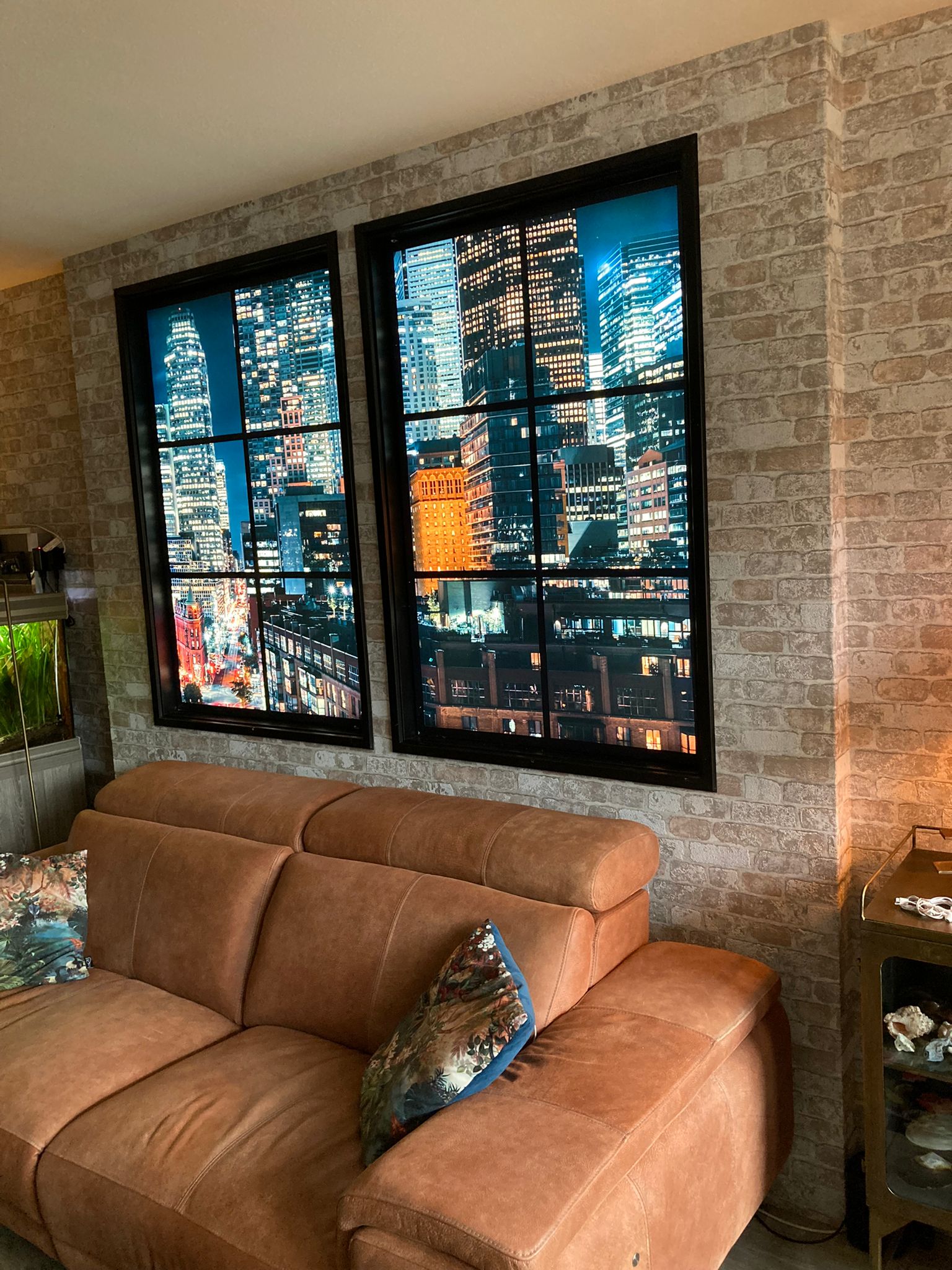
Veduta separates where you live from what you see. That quietly rewrites real estate, housing supply, and how we build cities.
Nothing in a Veduta is invented from scratch. It is a direct descendant of the video wall — tiled Direct-View LED panels with near-zero bezels, daisy-chained power and signal, driven by a wall controller — and specifically of ILM StageCraft, the LED-wall virtual-production stage known as "The Volume" built for The Mandalorian. Hollywood already shoots actors inside rooms whose walls are giant, photoreal, sun-bright screens.
It even runs on the same engine. On StageCraft, "ILM used Epic Games' Unreal Engine, a popular game engine, to handle real-time 3-D rendering of computer-generated imagery environments" — which is exactly what the Veduta prototype does to paint the view that shifts as you move.
We shrink the Volume to a single wall in a home and push three design axes a film set never had to care about: polarized stereoscopic 3D, extreme, sun-bright luminance, and per-viewer head tracking. The crucial difference is who has to be fooled. StageCraft only ever has to convince a camera, never the actors, so it never needed real stereo depth — but it does prove, today, that wall-sized, film-real brightness and reflections on skin and eyes are already achievable. We take that proven panel and make it persuasive to a person standing in the room.
Virtual reality tried to win by strapping a headset onto the viewer, and largely stalled because people don't want to wear one. Veduta solves the same presence problem from the outside in: the room stays your room, your furniture stays your furniture, and the surfaces around you simply get more and more indistinguishable from reality — the same great 3-D shapes, minus the bulky headset.
Star Trek already drew the destination — the holodeck. And really, why wouldn't we want it? Immersive 3-D worlds you can walk into in your own living room, glasses-free, furniture and all.
Today this is entirely feasible but cost-prohibitive. The components ride the same LED and MicroLED cost curve that collapses year over year, so the price keeps falling. And because a Veduta manufactures a view, it can be sold as something that raises the value of the real estate it sits in — a windowless or bad-view unit gains a premium outlook. Positioned that way, it pays for itself: the ceiling on its price is the value of the view it creates, not the bill of materials.
Proven hardware. New packaging. A window that pays for the wall it replaces.
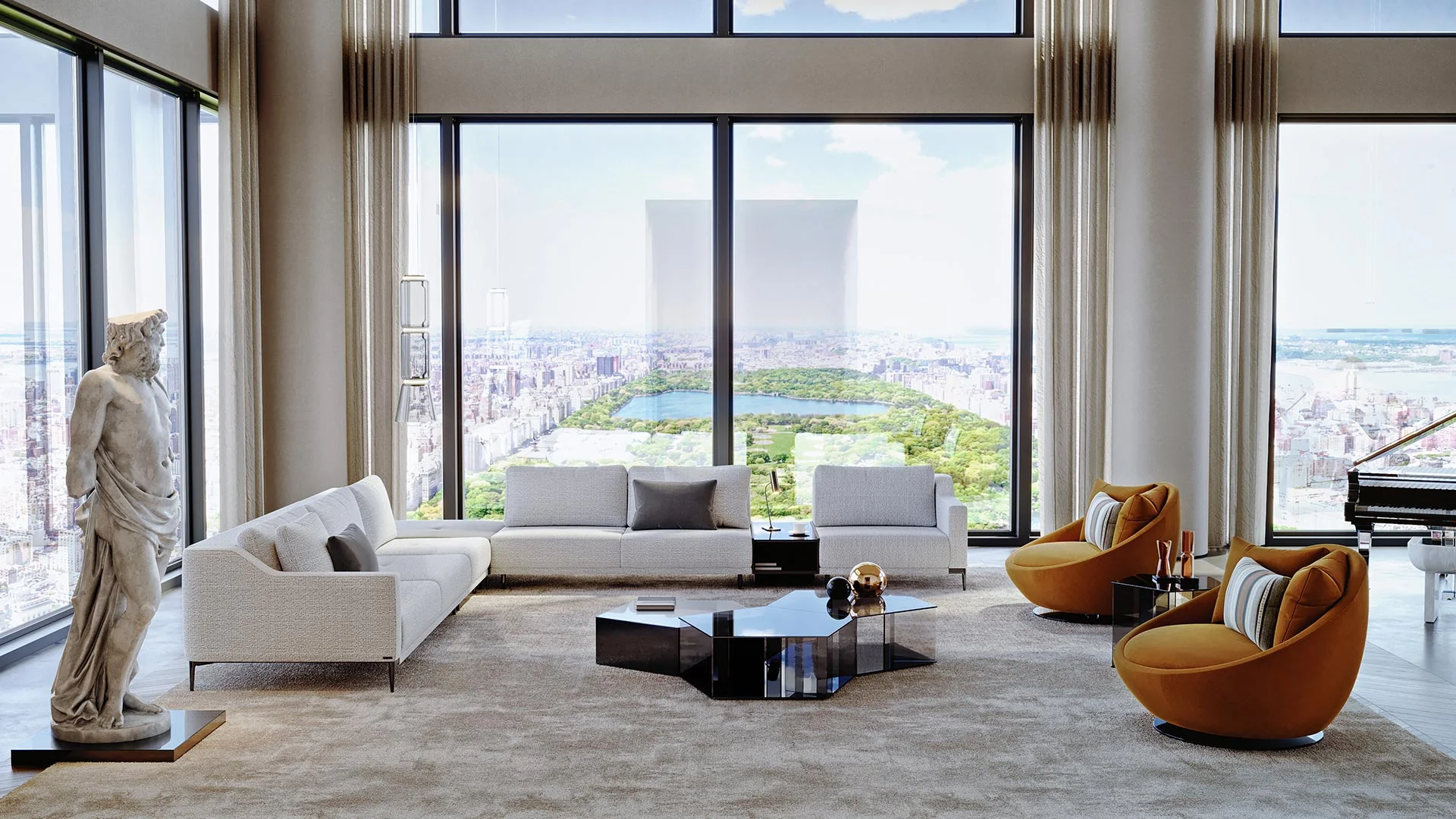
A view is one of the last great luxuries money can buy. A window over Central Park can be worth millions. Because Veduta passes the Window Turing Test, it commoditizes that view. Everyone can have it.
Everyone should have a view like that of a Central Park penthouse.
Once the view is yours to choose, the things that drive premium real estate — the floor you're on, the direction you face, the vista outside — stop mattering. People won't care what floor they live on, because their windows show whatever they like.
Buildings designed around Veduta can be built cheaply, almost anywhere, very large, and very fast. Where there's a housing crisis, supply can finally scale to meet it.
The new land strategy: buy near the best transport nexus — roads, transit, connectivity — because the view no longer matters. Step out of the elevator into your apartment and the view is whatever you've chosen. You won't know — and won't care — whether you're seven storeys underground or 40 floors over Central Park. Every room is a great room.
Taken further: once this technology is proven, buildings could be purpose-built with no real windows at all, lined instead with 3D screens as good as windows — or eventually VR headsets and contact lenses that pipe the view straight to your eyes, possibly cheaper than screens. If light goes to the eye directly, the building needn't even be lit. Sensors gather the world outside and relay it in, so each person can tune their own space to a completely different level of light.
No windows means a sealed envelope: HEPA-filtered, clean air in every room regardless of conditions outside, far simpler climate control, and very even temperatures throughout.
Such buildings can go underground where land is scarce — gentler on a city's skyline, as in San Francisco — and a deeply buried building is relatively safe from nuclear attack.
Veduta commoditizes the trappings of luxury — the views, the light, the sense of space — and hands them to everyone. Cheaper, faster, more resilient homes, with the experience of a palace.
A better window is a better world.
Veduta is not a television and not a window — it is both, and a light source, and the wall itself. Its market is therefore the union of those categories, not a slice of any one. The global display market runs to roughly $145–175 billion a year; the global window market to roughly $115 billion. Together — before counting the wall, paint, and décor surface that a window-onto-anywhere can claim — that is a quarter-trillion dollars of annual demand, and the built environment it can eventually re-skin is measured in the trillions. Once a panel passes the Window Turing Test, the real window becomes the inferior product: one fixed view, and a permanent hole in the wall. The question stops being who would install one, and becomes why anyone would still install glass.
We launch with the people who buy the future first — technology-forward early adopters, via pre-order. Their role is not revenue but proof: the demonstration, the waitlist, and the first rooms the world sees.
Owners of interior- and courtyard-facing homes in dense cities, where the view-side unit on the same floor sells for $50,000–$200,000 more. Here a Veduta pays for itself the day it is installed.
Basements, home offices, gyms, theatres, in-law suites — the most repeatable installation in the affluent home, anchored by the $5,000 wall window. A view where there was never a window to begin with.
Hotels, hospitals, senior living, offices, cruise cabins, spas — spaces with capital budgets and measurable returns: guest satisfaction, patient outcomes, staff retention. The fastest path to volume.
The near-term market is every windowless and bad-view surface — enormous, and legally clean. The maximalist case of buildings with no real windows runs into egress and natural-light codes, and waits on them.
The destination is the default interior surface. As the panel rides the MicroLED cost curve toward mass-market pricing, a window onto anywhere stops being a luxury and becomes the standard wall — a market on the order of $30–60 billion a year in the US alone, and a quarter-trillion and climbing worldwide.
The hardest single problem in a Veduta isn't depth or parallax — it's the panel. To pass for a real window, the surface has to be sun-bright, retina-fine, and thin enough to be placed flush against a wall without shrinking the floor space in the room. No existing display does all three at once.
Display brightness is specified in nits (candelas per square metre). For reference, a sunlit white wall reads at roughly 30,000 nits — about 100,000 lumens pour through a 1.5 m² window at noon. Most consumer screens live two orders of magnitude below that.
Peak vs. sustained matters. HDR marketing numbers usually describe a small bright zone for a fraction of a second; the figures above are full-panel sustained where stated.
A Veduta panel has to satisfy three properties at the same time:
Sub-pixel pitch. At a 1 m viewing distance, the human eye can resolve about one arc-minute, which works out to roughly 0.1 mm pixel pitch on the surface. Coarser than that and the grid becomes visible up close — and the grid shattering the illusion is exactly the failure mode we're engineered against.
Sustained high luminance. Not HDR peak, not "for one frame in a torch-test demo," but a full-panel emission that holds at ~15,000 nits indefinitely. That rules out almost every consumer display on the market: their peak figures are momentary and small-area.
Wall-flush thermal envelope. The panel has to dissipate hundreds of watts of waste heat without growing into a refrigerator-sized enclosure.
Each of these is solvable in isolation. The combination is what's hard:
Veduta sits in the unoccupied corner: retina-pitch, sustained ~15,000 nits, wall-sized.
Brightness costs watts. White LEDs in mass production today run around 150 lumens per watt of input. A 1.5 m² Veduta panel emitting at 15,000 nits is around 70,000 lumens of output — roughly 500 W of input power at peak. About half of that becomes heat.
Shedding ~250 W of waste heat from a wall-flush panel rules out passive cooling at this scale (you'd need radiator-class fins on the back). Veduta uses an active loop — heat pipes from the LED array into a low-RPM fan stage at the panel's edge — sized to stay below ~30 dB at full brightness. The thermal design ends up driving the industrial design of the unit more than any other constraint.
The head-tracker turns peak power into a duty-cycle problem. In a typical room — occupied a few hours a day, with the panel idle or dimmed the rest of the time — average draw lands around 75–100 W. Comparable to a TV plus a lamp, not a space heater.
The number that matters for a buyer is the running cost. Take the larger case: a Veduta Wall covering half a condo wall — call it a panel about 1.5 m wide by 2.5 m tall, roughly 3.75 m² of emitting surface. Linear scaling from the 1.5 m² reference puts peak input around ~1,250 W, and average draw (head-tracker dimming, realistic content, room empty most of the day) at around ~210 W.
Numbers are deliberately conservative; head-tracking on real usage patterns typically pushes this lower.
At the current US residential average (~$0.17/kWh) that works out to roughly $300–$320 a year. In higher-rate metros — New York, California — it climbs to ~$450/year; in cheaper utility regions it drops below $220/year. Less than the cost of cable, and a rounding error against the price of the unit on the "good side" of the building it replaced.
The first unit is a functional prototype, custom-rigged from off-the-shelf commodity parts. It's the same playbook Palmer Luckey ran when he wired together the original Oculus Rift in his garage from smartphone screens — proving a multi-billion-dollar concept while the tech giants were still ignoring VR.
To pass the Window Turing Test today, we brute-force the physics. The early prototype uses two custom subsystems:
Remote active liquid cooling. Sun-parity brightness costs serious wattage. Coolant lines run through the wall to a remote pump in another room, shedding ~1,000 W of waste heat without any audible noise at the panel itself.
Real-time stereoscopic parallax. A multi-camera depth-sensor array maps the viewer's head position and feeds a commodity PC running Unreal Engine, which either live-renders the view or instantly fetches the matching frame from a pre-rendered multi-angle scene.
The crude prototype rig will prove the experience, convincing VCs to fund our efforts just before the underlying MicroLED technology tracks steadily downward. By 2028–2030, raw panel costs for a 1.5 m² display are projected below $15,000 — making the $20,000 architectural model feasible at retail. Between 2030 and 2035, the same panel falls below $3,000, opening the door to a fully self-contained, air-cooled $5,000 consumer window.
v1 ships at ~15,000 nits sustained — roughly 50× a typical TV, half the noon sun, and already past the point where the panel reads as "daylight" to the eye rather than "a bright screen." From there, each generation rides three improving curves: LED efficacy (already approaching 250 lm/W in lab samples), thermal density (better heat-pipe and vapor-chamber designs), and MicroLED yield (which collapses cost per pixel). The long-term target is full sun-parity — ~30,000 nits, sustained, retina-pitch, wall-flush. That's a multi-generation bet, not a v1 spec, and we'd rather ship something genuinely good than promise something physics hasn't caught up to yet.
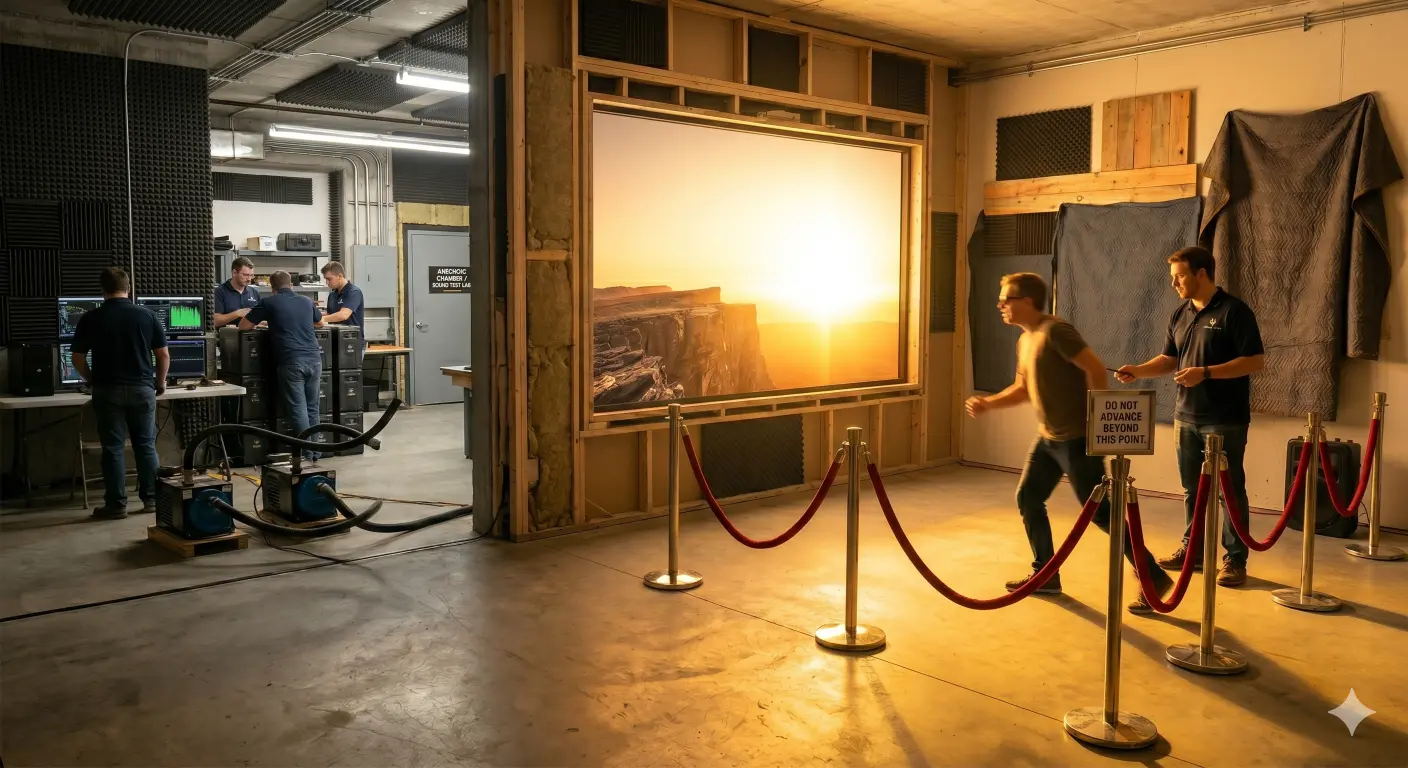
To prove a window is real, we don't need high-resolution foregrounds — we just need mathematically perfect depth and overwhelming, visceral power.
Our initial proof-of-concept is built not as a terrestrial window, but as a simulated viewpoint from an immense distance. It strips away the complexity of rendering intricate earthbound details. Instead, it relies on a silently cooled, low-resolution LED array pushing brutal, unfiltered lumens to display a distant, jagged cliff edge against the deep expanse.
It is designed to be felt as much as seen. When you stand in front of it, you wince at the glare. You feel the physical warmth of the sun radiating against your skin.
The entire proof-of-concept rig — liquid cooling, power banks, soundproofing, external diagnostic displays — can be built today for roughly $3,000. It solves the resolution problem by keeping you cordoned back: you perceive immense distance, not individual pixels.
Distance requires more than just an image; it requires stereoscopic physics. By having the viewer wear lightweight, polarized glasses — functioning practically as solar visors to mitigate the glare — we offset the image for each eye. This forces your eyes to physically uncross into perfectly parallel alignment, which is the exact physiological state of gazing into optical infinity. The common trade-off of polarized glasses reducing brightness by 50% becomes an essential feature: the remaining intensity is still staggering, yet manageable.
Combined with ultra-fast head tracking, the celestial and terrestrial bodies shift in perfect motion parallax against the physical frame as you move around the cordoned area. It is the minimum viable illusion: low resolution, staggering brightness, and infinite depth.
Our rig is essentially Hollywood in-camera front projection. On the Tom Cruise film Oblivion, the "Sky Tower" set was wrapped in a 270-degree, roughly 500 ft × 42 ft painted-muslin screen lit by 21 projectors at about 15K resolution. Crucially, that projected image was the actual light source for the scene — so the highlights and reflections on the actors' faces, eyes, and the glass walls were all genuine, captured in camera rather than added later.
It already looks film-real. Veduta is that same idea shrunk to a single wall in a home, with two things film never needed bolted on: stereoscopic 3-D and per-viewer head tracking. The modern, LED-wall version of the Oblivion screen is exactly the StageCraft "Volume" — proof that wall-sized, sun-bright, photoreal panels are a solved problem, not a research bet.
We don't need to build the final panel to start proving the illusion. Each step below isolates a single variable, from a pure-software toy to a head-to-head test against real glass.
A webcam head-tracker in JavaScript that shifts a pre-baked scene as you move — no hardware at all. This one is already live: it is the window in the hero on the home page. Move your mouse over it, or switch on head tracking.
The same browser head-tracker now driving a real 3-D computer-generated scene (React Three Fiber), so the parallax is computed from true geometry instead of a flat image.
A single very bright LED panel behind a diaphanous sheer curtain, no polarization yet. The only goal of this step is to confirm the light can be driven bright enough to read as actual sun.
The same rig, now circularly polarized with passive glasses, to add the stereoscopic "gazing into infinity" depth on top of the brightness.
Raise the pixel density until the scene survives without the curtain hiding the gaps, and remove it.
Find a location with a static scene behind real glass — kept indoors but brightly lit to control for lighting — and sample it with a camera from every vantage point in the room. Use AI to fill the gaps into one continuous, perfect light field. Then replicate that scene on our display on the opposite side, and ask people to tell which side is real glass and which is the panel. Curtains are allowed at first to make a pass possible. No real-time rendering is required: we simply replay the correct captured frame for wherever the head-tracker says you are.
Progressively improve the panel until it passes the same test with fewer curtains, then none — closing the gap to a bare, naked window.
For the very first room-versus-room comparison, the panel will still be crude, so we lean on perceptual tricks to keep the illusion intact:
Hide the imperfections. Put a diaphanous curtain in front of relatively low-resolution LEDs — but with no gaps between the modules — drive the light bright enough that it reads as the sun, and have viewers wear the polarized glasses so the scene sits far, far beyond the window frame.
Or just kill depth perception. The minimal version is even cheaper: put a pirate-style patch over one eye during the comparison, removing stereo depth entirely so head-tracked motion parallax alone has to carry the illusion. Then film a static but complex outdoor scene with a camera moved through every vantage point in the room, and simply show the correct frame for wherever the head-tracker thinks you are. No rendering, no live engine — just play back the right photograph.
The whole rig is built from commodity parts. Rough, off-the-shelf estimates:
Figures are rough commodity estimates and land comfortably under the ~$3,000 budget once shipping and spares are added.
Stage 0 above is already running on the home page. The window in the hero follows your mouse out of the box; switch on head tracking and it follows your head instead, so the view gains depth from motion alone. Nothing leaves your device — the camera feed is read on the page and never uploaded.